MEDENTiKA: Integrated Communications for a Dental Implant Manufacturer
Five-year end-to-end communications partnership covering website, print, video, and international marketing — building a consistent, scalable communications system for a regulated medical device manufacturer within the Straumann Group.
Overview
MEDENTiKA GmbH (Hügelsheim, Germany) manufactures dental implants and prosthetic components. Working as part of a three-person team — project lead WeberFink GbR, web developer boettner.it, and myself handling design, concept, and coordination — I provided comprehensive communications support from 2015 to 2019 across digital, print, video, and strategic projects.
Problem
MEDENTiKA had a grown corporate design but no integrated communications strategy. Website, print materials, video tutorials, media library, and international sales collateral operated independently without cohesion. As the company grew within the Straumann Group, the demands for professional, internationally scalable communications increased significantly.
Constraints
- Dental implants are regulated medical devices — all documentation (IFU, surgical guides) must meet CE and MDR requirements,All changes to regulatory documents require formal approval from management and the Head of Global Marketing.
- Communications had to work across multiple languages (DE, EN, TR, CZ) and markets.
- Three-party team structure required clear handoffs and self-sufficient working during absences.
- Budget-conscious mid-size company competing against specialist healthcare agencies.
Approach
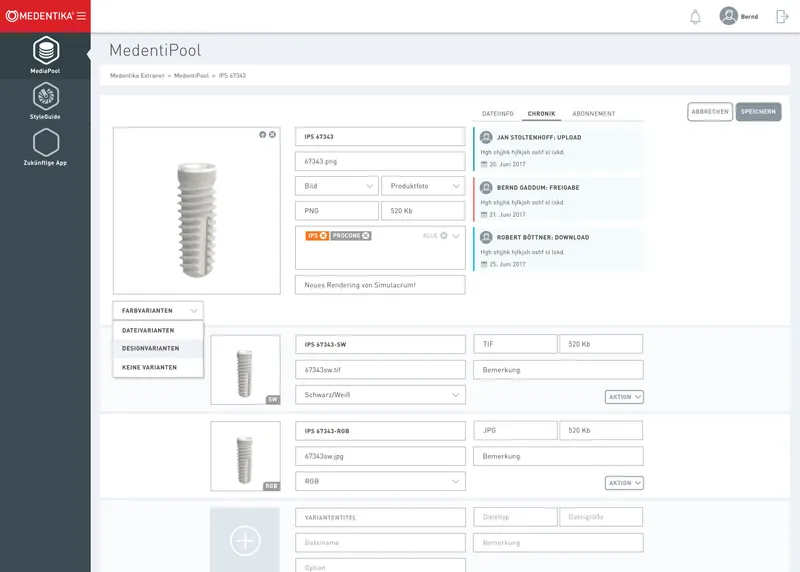
Established a consistent visual language across all touchpoints and built reusable systems — template libraries, extranet structure, video intro/outro frameworks — that could scale without starting from scratch each time. Worked closely with the web developer on design handoffs and UI specs, coordinated all external vendors (video studios, translators, printers), and contributed strategically to digital concept development and campaign pitches.
Project deliverables
Implement a fully integrated communication system across web, print, video, and trade shows.
Fragmented communication limited scalability and effectiveness in an international, regulated environment.
Implement notification deduplication at the platform level
Duplicate notifications were a major user complaint. Platform-level deduplication with configurable windows prevents duplicates regardless of how many times upstream services trigger the same notification.
- Rely on upstream services to deduplicate
- Client-side deduplication
Use Apache Kafka for notification queue
Kafka's durability guarantees and replay capability are essential for notifications. We can't lose notifications, and we need the ability to replay failed batches. The partitioning model also enables parallel processing.
Design disciplines
- Branding
- Web
- Social Media
- Illustration
Result & Impact
- 99.95% (up from 94%)Delivery Rate
- 50M+ notificationsDaily Volume
- Reduced by 95%Duplicate Complaints
- 30% reduction through smart routingProvider Costs
Built a coherent, internationally usable communications system from a fragmented starting point. Regulatory documents (IFUs, surgical guides) were produced in consistent, approvable formats. The team structure allowed continuous delivery even during absences — the project lead's illness never caused a missed deadline. The Procone pitch demonstrated that a small team could compete on concept quality against specialist healthcare agencies.
Learnings
- In regulated industries, design is never just aesthetic — every decision has a compliance dimension.
- Reusable systems (templates, frameworks, naming conventions) pay dividends over multi-year engagements.
- Three-party team structures need explicit role clarity and self-sufficiency — coordination overhead is real but manageable.
- Competing against specialist agencies requires leaning into agility and client knowledge, not trying to match their production scale.
- SEO anomalies are rarely single-cause — the 2017 visibility drop required cross-referencing technical, content, and competitive factors before conclusions could be drawn.
Working in a Regulated Environment
Dental implants are classified medical devices. Every IFU (Instructions for Use) and surgical guide had to meet CE marking requirements and the EU Medical Device Regulation — meaning formal approval workflows, version control, and multilingual accuracy weren’t optional extras but baseline requirements. This shaped the entire working process: changes were documented, approvals tracked, and print files never sent without sign-off from both the Head of Global Marketing and the managing director.
The Three-Party Team Model
The collaboration followed a clear division of labour: WeberFink GbR handled client relationship and project management, boettner.it owned technical web development, and I covered design, concept development, and vendor coordination. This model worked well precisely because roles were explicit. When the project lead was ill for an extended period, I coordinated directly with the client and kept delivery on track — the structure made that possible without friction.
Pitch Against Specialist Agencies
In 2019, the team pitched for the Procone campaign against two specialist healthcare communications agencies. We placed second. The concept was well-received on content and strategic grounds — the gap was execution ambition and production scale, not strategic thinking. It was a useful calibration: a three-person freelance constellation can compete on ideas with specialist agencies, but closing that gap on production volume requires either a larger team or a narrower scope.